ISBN: 0-9763857-7-5 (Hardback)
Pages: 352
Publication Date: May 2006
About the Author
Allan L. Smallidge was born in Winter Harbor on January 11, 1933.
He grew up in Winter Harbor, graduated from Winter Harbor High School,
and received a Master's degree from the University of Maine.
He served in the U.S. Air Force, following which he worked as a high
school teacher in Massachusetts for many years.
Upon retiring from teaching in 1986, Allan moved back home and worked as
the town manager of Winter Harbor for the next ten years.
Allan died at the age of 73, on March 4, 2006.
Allan's love for the town in which he was born was rivaled only by his
knowledge of its history.
Far more than the town's historian, Allan was a caretaker of Winter
Harbor's past and a vital, committed, and passionate participant in the
events that shaped Winter Harbor during his lifetime.
|
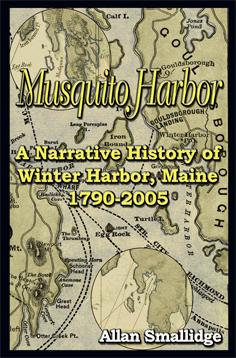
Musquito Harbor
presents the history of a small, Downeast Maine coastal town whose
residents secured their independence as a community in 1895 and never
looked back.
They named their town Winter Harbor, and, while the town itself may
be small, there is nothing small about the people who have made Winter
Harbor their home or about the events that have transpired during its
100-plus year history, as the author of this book, Allan Smallidge,
makes abundantly clear.
Musquito Harbor
describes:
-
The early settlement of the Schoodic peninsula, the town of
Gouldsboro and its control of the peninsula,
and the incorporation of the town of Winter Harbor.
-
Individuals who contributed to the creation, growth, and character
of the town, such as Bedford E. Tracy, E. J. Hammond, Dr. Almena Baker,
Freeland Bunker, and John G. Moore.
-
The history (and legends) of Schoodic Point, and its transformation
into the Schoodic section of Acadia National Park.
-
The formation of the Grindstone Neck summer community, its evolution,
and its impact on the town.
-
The makeup and operation of the town's government.
-
The history of the town's common schools and high school.
-
The building and changing uses of the libraries, churches, lodges,
and meeting halls of Winter Harbor.
-
The town's lighthouses, hotels, inns, stores, and businesses.
-
The ocean – as workplace, as a source of recreation, and as artistic
inspiration.
-
The fires that shaped the history and appearance
of the town, and other tragedies that remain an indelible part of
the town's past.
-
The lasting and the short-lived impact of war on the town and its
inhabitants.
-
The history of the graveyards of Winter Harbor, including illustrations
of the division and ownership of the plots in each of the graveyards.
|