



| The Information Revolution | |
|---|---|
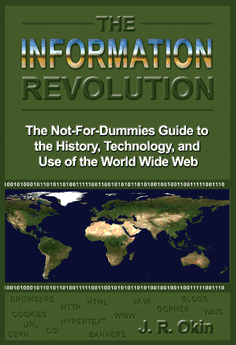
ISBN: 0-9763857-3-2 (Paperback) ISBN: 0-9763857-4-0 (Hardback) Pages: 352 Publication Date: September 2005
Click
HERE
to view the book's table of contents (PDF file).
|
Who created the Web and why?
How did its introduction change the Internet?
How did the Web change the management and operation of businesses, government
agencies, research and charitable organizations?
How did it affect the way we locate information, buy products,
and entertain ourselves?
Why did it dramatically impact the use of computers and computer networking?
This book answers these and many other questions about the
World Wide Web, its history, and its use. It's not uncommon to hear people refer to the Internet and the Web as if they were one and the same thing. There are good reasons why many people make this mistake and why many people are unclear about the relationship between the Web and the Internet. Journalists and newscasters routinely use the two names interchangeably, which is one obvious source of the problem. Another source of the problem - this one far less obvious but of greater impact - has to do with the evolution of Web browsers. Netscape's Navigator and Microsoft's Internet Explorer, which are the two most popular tools for surfing the Web, have become multipurpose network applications that are used for exchanging and managing email, interacting in chat rooms, and other common Internet activities. None of these activities have any connection to browsing the Web, but use of these applications blurs the distinctions between the Web and other services on the Internet as well as between the Web and the Internet itself. This book was written to make these distinctions clear. It explains in a manner that anyone can understand exactly how the Web operates as a service on the Internet and how its system for managing and sharing information functions. |
|
Click HERE to return to the previous page. | |